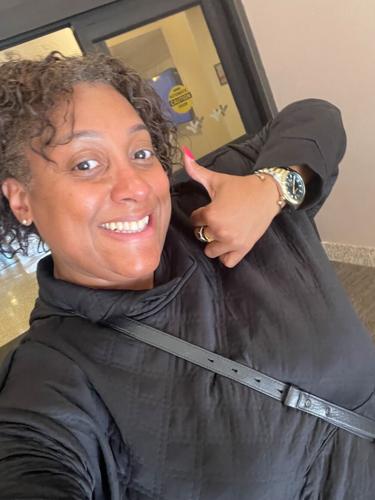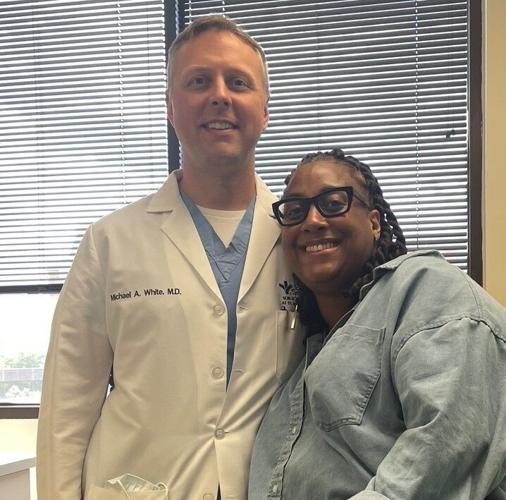



Javona Braxton and oncology surgeon Michael White, M.D.
Javona Braxton will never forget the date. May 18, 2023. She was 46 and had just undergone a routine colonoscopy.
Her gastroenterologist, Bimaljit S. Sandhu, M.D., did not have good news. They’d found a mass in her colon that could be cancer, and they were sending it to the lab for a biopsy.
“My heart sank and I could feel tears welling up in my eyes,” Braxton said. “I tried to ask questions, and my voice was shaking.”
But she appreciated Dr. Sandhu’s gentle bedside manner and his assuring words: “This is all fixable.”
Still, as Braxton waited for the results, it was hard to calm her anxiety. Finally, Dr. Sandhu phoned. The mass in her colon was malignant.
Oncologist Rachna Raman, M.D., did further testing. It appeared to be an early-stage cancer, but only after surgery could they know for sure how extensive it was.
Next Braxton consulted with oncology surgeon Michael White, M.D., who recalled their first visit.
“She’s a very charismatic person with a wonderful personality,” Dr. White said. “But obviously she had a lot of concern. I don’t think anyone in their mid-40s expects to find something that’s going to alter their life going forward.”

Surgery day
The importance of comprehensive cancer care
At Bon Secours, medical teams work together to provide the best possible care for cancer patients. Each case is reviewed by a tumor board composed of health care professionals in the specialties relevant to the individual’s cancer.
“Cancer care here is not a unilateral decision made by one person,” Dr. White said. “It’s a group decision based upon multiple disciplines of cancer treatment, as well as discussions with the patient.”
Surgery was recommended as the first line of treatment for Braxton.
White performed laparoscopic surgery, a minimally invasive approach, using small incisions, that generally has an easier and faster recovery time than traditional surgery.
Surgery also confirmed that her lymph nodes had not been affected and the cancer hadn’t spread.
“Thankfully, her pathology showed it was a stage 1 tumor, and she didn't need any additional therapy,” Dr. White said.

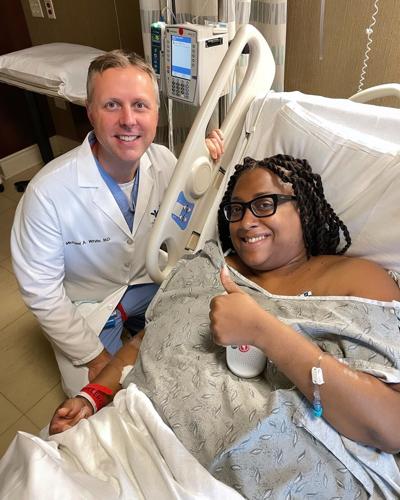
Javona Braxton post-surgery
Why colon cancer screening should begin at 45
Braxton had been stunned to learn she had colon cancer.
“We don’t have a family history and I had no symptoms of colon issues,” she said. “I don’t eat poorly, I stay active, and I have regular checkups with all of my doctors. I kept thinking how?”
What’s more, she was only 46 at the time, and colon cancer had always been a disease typically occurring in older people.
However, in recent years there has been such a significant rise of colon cancer diagnoses for younger people, that in 2021 the U.S. Preventive Services Task Force lowered the recommended age to start screening from 50 to 45.
That’s why Braxton went for a colonoscopy last year. It’s lucky that she did, because the earlier colon cancer is discovered, the better the outcome is likely to be.
“So far, there’s no sign of any recurrence,” said Dr. White. “I just saw her recently and she’s doing very well.”
Click here to learn more about cancer care at Bon Secours.