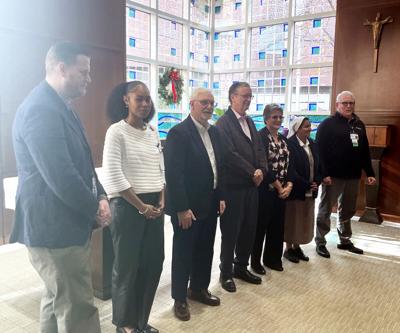



Spiritual Care Partners Program 2025 graduation
Bon Secours is widely respected for its advanced medical care, and as a faith-based health system, it also recognizes the powerful role of the human spirit in healing and recovery.
That’s why, in 2013, Bon Secours created the Spiritual Care Partners Program. While rooted in a Catholic tradition, the program is entirely nondenominational.
“We’re here to support the needs of anyone in the hospital, whether they hold deeply religious convictions or not,” said Chaplain Jeffrey Walton, MDiv, MS, BCC-PCHAC, staff chaplain and Spiritual Care Partners Program coordinator. “We provide a compassionate, nonjudgmental presence for people who are vulnerable and going through a hard time.”
Care and connection
This past year alone, the program’s chaplains and volunteers have helped more than 5,000 Bon Secours patients, their families and caregivers — and their work is quite special.
One of the most important things the chaplains and volunteers do is form a genuine connection with people. Sometimes this means listening to their worries and concerns, or to the personal stories they want to share. At other times all they might need is someone to be there with them and hold their hand.
Providing this care for the human spirit can help patients find hope during a difficult time, often by discovering a connection to something greater, something beyond themselves, whether they find it in God or in a deeper understanding of their purpose in the world.
Walton remembered one patient he had a particularly soft spot for.
“This man had lost his spouse many years ago, had no children and needed companionship. He wasn’t religious — I think he said he was an atheist — but he had an encyclopedic memory of rock music. As we listened together to the music he loved, he realized that this is what gave meaning to his life,” Walton said.
Volunteers receive intensive training
People interested in becoming a Spiritual Care Partners volunteer must first complete an intensive 10-week course, modeled on the training chaplains themselves undergo, that has been rigorously structured to prepare people for this work.
The course includes in-person academic classes, online learning modules and in-hospital clinical training.
During the clinical part of the course, trainees shadow one of the hospital chaplains, observing how they conduct a visit, how they introduce themselves and how they initiate and deepen a conversation. Then, the roles are reversed and it’s the volunteer who interacts with the patient and gets feedback from the chaplain.
They learn that spiritual care is not about quick fixes or having the right answers or changing someone’s religious beliefs — something they are not permitted to even attempt. It’s about the gift of presence and truly listening to the stories that make up a person’s life.
As Walton explained, “Something special happens when you say, ‘Hey, can I pull up a chair and sit with you? I’m here for you, whatever you need.’”
For more information, go to bonsecours.com.