
“You can do so much because the teachers here are really willing to work with you, which is one of my favorite things about VMI.”
- Abigail Basener, Class of 2024

At VMI, interdisciplinary research projects are common. Basener said, “I do a ton of research. I’ve done research with history teachers. I’ve done research with math teachers and with engineering teachers.”
Ever since chatbots powered by artificial intelligence became widely accessible last year, there’s been much hand wringing about how the technology might mean the end of student writing assignments.
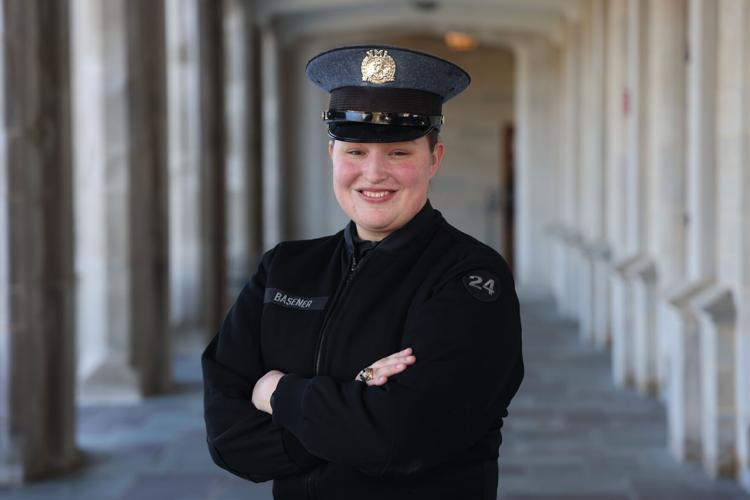
It’s a valid concern. But at a small school in western Virginia, one student is working to develop software to detect whether AI wrote a student paper. Abigail Basener, a member of the class of 2024 at Virginia Military Institute in Lexington, Virginia, is conducting an honors project aimed at developing tools that can tell the difference between human- and machine-generated content.
“My goal is to investigate those tools and learn how they work, learn how the detection algorithms work through building my own detection tool,” Basener said.
Sentence structure, sentence length and word usage all come into play: Wherever AI-generated text varies significantly from the way humans write, there may be a way to sniff out whether a student actually wrote a paper they put their name on.
At a typical school, one might expect such research to be done by a graduate student enrolled in one department, working with one professor. But at VMI, which has an enrollment of about 1,600 students, interdisciplinary projects are common — and Basener’s is no exception. For her AI chatbot research project, Basener is receiving guidance from professors in three different departments: applied mathematics, computer science and English.

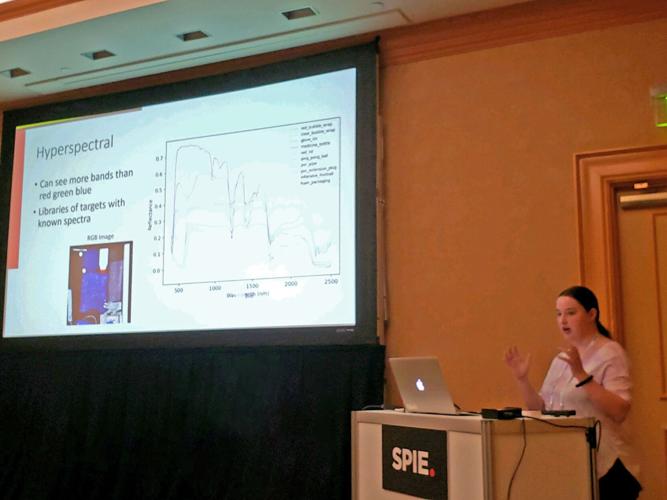
Basener has attended and spoken at multiple research conferences as far away as Rome, Italy.
For Basener, such collaboration is a welcome reminder that learning shouldn’t be separated into silos. “It’s so much fun to be able to work with different research projects and for teachers in different departments,” she said. “And you get to branch out and understand how different people approach projects, how different people think about different problems.”
An applied mathematics major with a minor in economics and business, Basener came to VMI after earning an associate degree in computer science. And while it would have been easy to enroll in a typical college afterward, Basener was seeking something more.
“I came to VMI because I was looking for something a little bit different,” she said. “The traditional college didn’t seem to have enough responsibility or rigor. So, I wanted something that would push me a little bit further, that would require a little bit more.”

At VMI, Basener found a different type of college experience. “The traditional college didn’t seem to have enough responsibility or rigor,” she said. “So, I wanted something that that would push me a little bit further, that would require a little bit more.”
Basener found what she was looking for. At VMI, students, who are called “cadets,” all wear uniforms, live in barracks and participate in military training exercises. Military commissioning is optional. The school has long been known for its exceptional commitment to undergraduate education, with a 10-to-1 student-to-faculty ratio, and ample opportunities for mentored undergraduate research.
“You have a lot more opportunities to do things you wouldn’t have at a bigger school,” said Basener. “So, I do a ton of research. I’ve done research with history teachers. I’ve done research with math teachers and with engineering teachers. I’m currently starting some research that I’m doing with an English teacher. You can do so much because the teachers here are really willing to work with you, which is one of my favorite things about VMI.”
After VMI, Basener plans to attend graduate school for math, computer science, data science or statistics — or possibly a combination of those fields. As she ponders her next steps, she’s very glad she chose the path less traveled.
“There’s as many academic opportunities at VMI as you make,” she said. “There’s so many things I wouldn’t have been able to do if I wasn’t at VMI.”
For more information, visit vmi.edu.