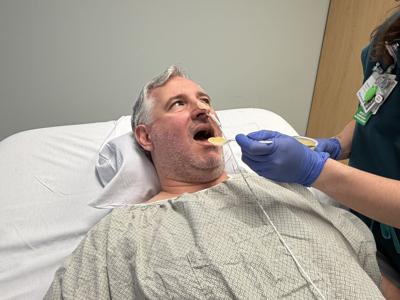


A Bon Secours speech-language pathologist demonstrates the administration of pharyngeal electrical stimulation (PES). The photo has been staged for illustrative purposes; the individual pictured is not an actual patient.
Almost half of all stroke patients have trouble swallowing, a condition known as dysphagia. In some cases, it can lead to serious, even life-threatening complications.
Treatment for dysphagia can include exercises and other therapies led by speech-language pathologists, but those approaches can be challenging for patients whose strokes have affected their physical or cognitive abilities.
For patients who have difficulty participating in traditional therapy or may benefit from a more personalized approach, Bon Secours St. Mary’s Comprehensive Stroke Center has added another treatment option to its approach to dysphagia. The hospital is the first in Virginia to offer a new technology that uses pharyngeal electrical stimulation (PES) to activate sensory nerves involved in swallowing.
At Bon Secours St. Mary’s, treating dysphagia is part of a broader, multidisciplinary approach to stroke recovery. Speech-language pathologists work alongside neurologists, nurses and other members of the care team to evaluate each patient’s swallowing function and determine the safest and most appropriate treatment plan.
Depending on the patient’s needs, treatment may include traditional swallowing therapy, close monitoring and, for appropriate patients, newer approaches such as pharyngeal electrical stimulation.
“Previously, many patients weren’t able to participate in traditional therapy,” said Rachel Greif, a speech-language pathologist at Bon Secours St. Mary’s Hospital. “The fact that we now have a way to treat them can be life-changing for so many people.”
What causes dysphagia — and the toll it takes
Normally, when you eat or drink, sensations in the mouth and throat trigger a swallow response, then the throat muscles squeeze food down into the stomach. A stroke can numb those sensations, so the muscles can’t respond. Liquids, food and saliva can enter the airway, causing coughing, choking or infection.
There are also cases of “silent aspiration,” where patients don’t have enough sensation to cough or choke. It’s not only dangerous; it also means the problem isn’t always obvious. That’s why stroke patients at risk for silent aspiration and dysphagia may undergo testing to better evaluate their ability to swallow. A modified barium swallow study or a flexible endoscopic evaluation can provide objective information to help guide the plan of care.
As for the toll dysphagia can take, stroke patients with impaired swallowing spend an average of 10 days longer in the hospital — more if they need a feeding tube. They’re also more likely to develop pneumonia, and they face an eight-times higher mortality rate in the three-month period after their stroke.
Expanding treatment options for patients
This technology delivers pharyngeal electrical stimulation via a small, temporary tube placed through the nose to activate sensory nerves in the throat that communicate with the parts of the brain responsible for swallowing. This stimulation promotes neuroplasticity, the brain’s remarkable ability to reorganize and strengthen neural pathways after a stroke. This process helps healthy areas of the brain compensate for areas affected by the stroke, helping patients regain swallowing function.
“Every patient’s stroke and recovery is different, so we’re always looking at what treatments and therapies will give each individual the best opportunity towards healing,” Greif said.
Treatment is administered by the speech-language pathology team over a short series of sessions, followed by reassessment to determine the patient’s progress and next steps.
“Since we were the first hospital in Virginia to use this treatment option, no one had ever seen this before,” she said. “We started the treatment, and the patient, who couldn’t eat or drink, began to swallow — and swallow and swallow. Seeing that happen was just incredible.”
One patient’s road back to swallowing
One of the first patients Greif treated with the technology saw positive results, providing an early indication of its potential.
The patient was in his 50s and had suffered a stroke in his cerebellum, the part of the brain that coordinates the muscle movements involved in swallowing. At first he needed intubation to breathe, and when the tube was removed, his swallow response was severely impaired.
Greif and the care team incorporated pharyngeal electrical stimulation into his treatment plan, including a period when he again required respiratory support. Over time, his swallowing function improved.
“After two treatment cycles, he was able to eat and drink and continued making progress in his recovery.” she said.
For more information, visit bonsecours.com.