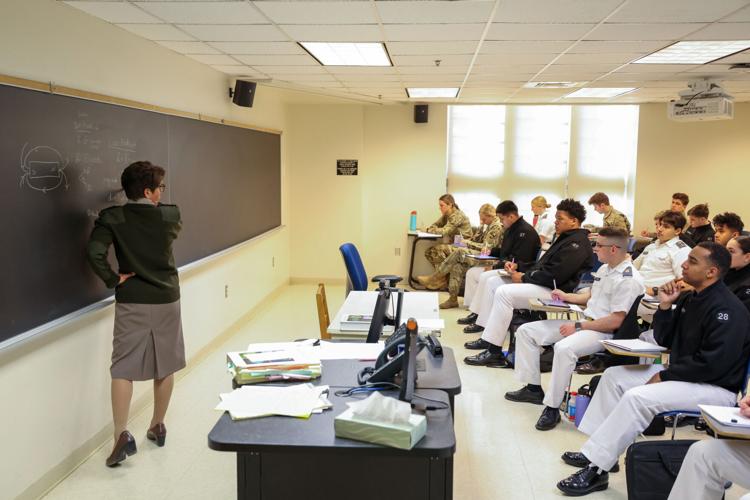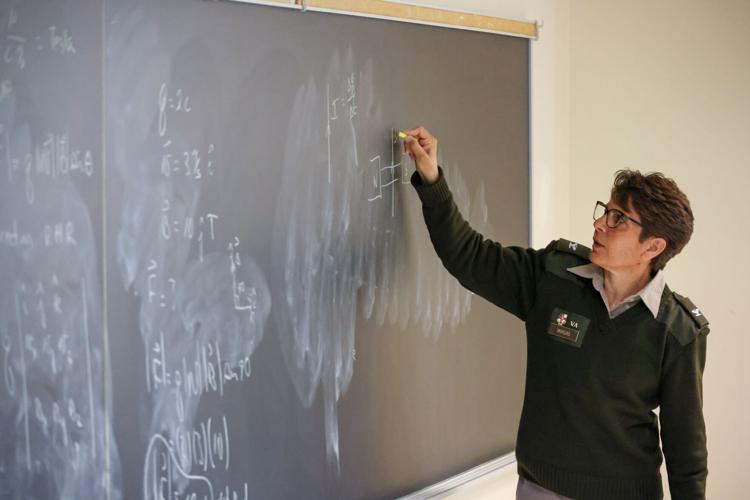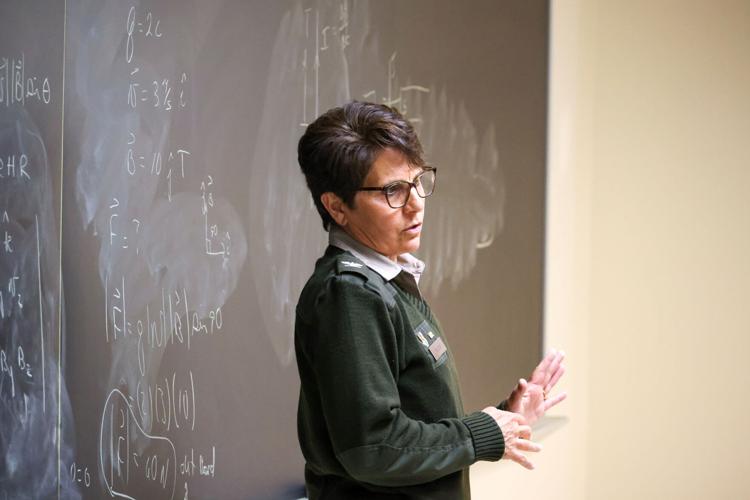


Stacia “Stacey” Vargas, Ph.D., chair of the Department of Physics and Astronomy at VMI
“While many things have changed, VMI remains fundamentally the same — a small institution that continues to prioritize teaching, mentoring and cadet success.”
- Stacia “Stacey” Vargas, Ph.D., chair of the Department of Physics and Astronomy at VMI
In 1996, Stacia “Stacey” Vargas, Ph.D., graduated with a doctorate in physics and accepted a one-year position at Virginia Military Institute, a small college in western Virginia known for its strength in the STEM disciplines and dedication to undergraduate teaching. At the time, she never thought she’d stay beyond the required year — but fast forward to 2025, and Vargas is not only still at VMI but chair of the Department of Physics and Astronomy, as well.
It’s the students, referred to as cadets at VMI, who have driven Vargas’ decision to stay for almost three decades. Faculty in the department made it clear when she was hired 29 years ago that cadets would be the driving force of everything she did, and that’s as true today as it was in the 1990s.
“[Physics department faculty] made it clear that VMI was a unique place,” Vargas said, “and they emphasized that my role would extend beyond teaching to include mentoring cadets and becoming an integral part of their cadetship.” So impressed by the department, the Institute, and most importantly, the cadets, Vargas turned down a tenure-track position at another institution and accepted VMI’s offer.

“While many things have changed, VMI remains fundamentally the same — a small institution that continues to prioritize teaching, mentoring and cadet success,” Vargas said. She also appreciates the close-knit community of the Institute. “If a cadet is absent from class, I reach out to ensure everything is all right. The VMI faculty genuinely care about the cadets and their success, both at VMI and beyond.”
Over the past few decades, undergraduate research has come to the forefront at many smaller colleges and universities, and this is especially true at VMI. For Vargas, guiding cadets as they make new discoveries in the lab is one of the most enjoyable parts of her job.
“Research is important because it allows cadets to explore unanswered questions,” she said. “It encourages deeper thinking and learning, challenges their problem-solving skills, and most importantly, provides them the chance to work closely with a faculty mentor — and vice versa!”

And while Vargas has now seen hundreds of her former students receive a VMI diploma, she had a moment of special pride in 2022 when her daughter, Maria Vargas, became one of them, graduating with a Bachelor of Science degree in civil engineering and commissioning into the U.S. Navy. “It was a great experience for her,” Stacey Vargas said, “and she really made the most of the opportunities VMI provided to help her develop as a leader.” Maria is now an officer in the U.S. Navy Civil Engineering Corps (known as the Seabees).
Today, as department chair, Vargas is the one asking the questions when prospective job candidates come to VMI — and she’s not shy about selling them on cadets.
“Cadets are amazing young men and women who choose a more challenging educational path than their peers do,” she said. “They value honesty, accountability, and integrity and are committed and engaged.”
“And, quite honestly, I tell job candidates, if they join us, they’ll soon consider themselves to be very spoiled to be teaching at VMI.” She paused. “Who knows? In time, they might think of teaching at VMI as I do: As the best job in the world.”
For more information, visit VMI.edu/neversettle.