

At first glance, the crimson roses climbing a perfectly seamless three-tiered cake appear as though they were snipped from the garden moments earlier. But looks can be deceiving. These petals took hours to form — just not in the way that requires soil, water, and sunlight. Instead, they were shaped from sugar, guided by intricate tools, and brought to life through a careful balance of patience, precision, and artistic skill practiced by some of Virginia’s most talented sugar artists.
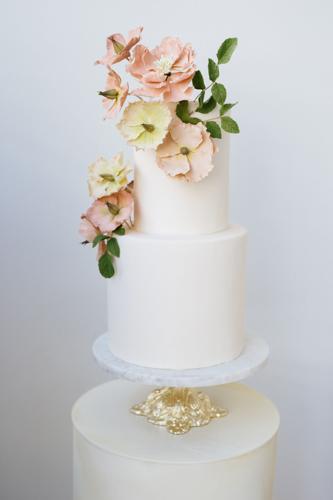
Sugar flowers, sculpted from gumpaste — a pliable sugar dough — are a masterful illusion. Designed to adorn cakes, each delicate petal and stem is meticulously cut, carved, molded, and assembled by hand. The result is a botanical replica so lifelike it blurs the line between art and nature, showcasing a craft that relies as much on technical expertise as it does on imagination.
People are also reading…

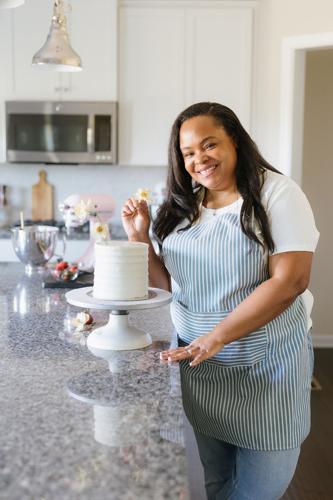
“It’s kind of like Play-Doh for cake,” says Tiffany Rosales, who has dabbled with sugar flowers for nearly five years. The owner of Charlottesville’s Commonwealth Cake Company discovered her passion after taking entry-level classes with Maggie Austin, a renowned sugar flower artist based in Alexandria. “I fell in love with it,” says Rosales. “It’s not something really offered in the area. I’ve been taking classes with her ever since to grow better and learn techniques.”
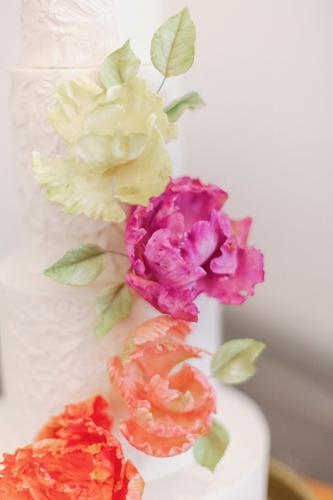
Luxurious roses, carnations, and fruits like succulent blackberries and whimsical strawberry leaves are just a hint of Rosales’ botanical repertoire. Her fluffy peonies, however, tend to be among the most popular. “It’s a big bloom. I use one or two to make a huge impact without blowing the budget,” she says.
Rosales carefully shapes and cuts each petal out of gumpaste before letting them cure — a process that can take a day or two, depending on factors like temperature and humidity. After assembling the petals, Rosales grabs a paintbrush to apply petal dust (a dried, edible pigment) to give each one more elevation and pop.
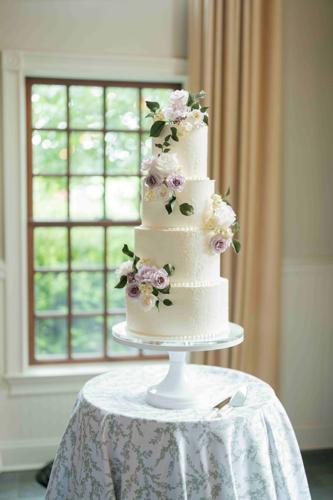
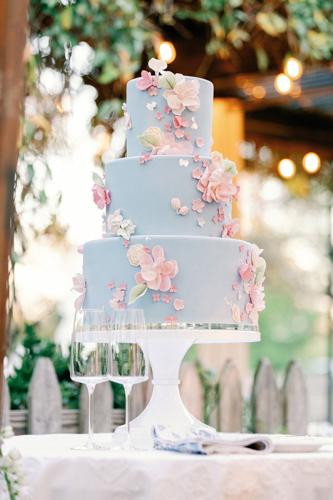
Commonwealth Cake Company
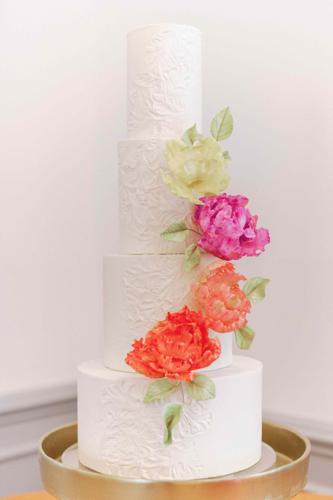
While sugar flowers stand out on their own, the secret to truly emphasizing them is adding additional features, like foliage, buds, and tiny filler flowers. “Some people don’t want greenery, but you do need something to accent the flowers,” she says. If traditional green hues aren’t preferred, Rosales will incorporate white, silver, or gold accents for dimension.
Rosales has recently started working with flexible gumpaste, the edible equivalent of cold porcelain clay that’s still pliable when dried and won’t break or lose its shape if accidentally dropped. That is perhaps a sugar flower artist’s biggest fear — to find that a bloom lovingly created over weeks of time has been shattered or chipped. Sometimes though, these so-called faults are what make the flowers more realistic. “The beauty of sugar flowers is to embrace the imperfections,” says Rosales. “No flower is perfect in nature anyway. If something breaks it's still beautiful.”
And unlike real flowers that wilt and shrivel away, sugar flowers are immortal. “They’re a keepsake — a little memento you have from your wedding day,” says Rosales. “Your flowers die; [these] don’t.”

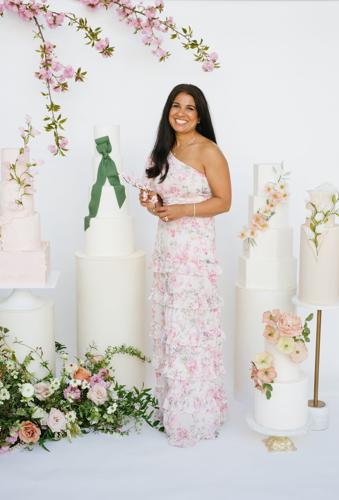
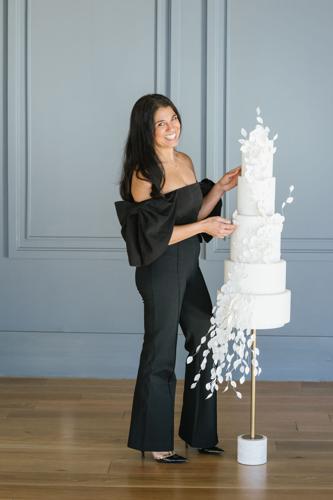
Also based in Charlottesville, Anita Gupta of Maliha Cakery approaches sugar flowers with a studied eye, quietly dissecting real blooms and investigating every petal, curve, and tint to guarantee botanical accuracy before recreating them in sugar.
Gupta has been designing cakes for more than 15 years and began crafting sugar flowers in 2013 as wedding trends evolved, dedicating significant time and patience to mastering the technique. “My first rose compared to now was totally different,” Gupta says. “It was a lot thicker back then.”
Her most requested blooms include peonies, roses, and orchids, but Gupta is committed to keeping the botanical possibilities open-ended. “On dummy cakes I’ve done hellebores. I’m hoping a client would want them on a real cake,” she says. “Those stamens are so beautiful; there’s an artful curve to them.”

Unlike wafer paper flowers (crafted from a thin, starch-based material), gumpaste florals are heavier and must be carefully engineered to prevent them from toppling off a cake. Each petal is wired individually and, once dried, assembled into a complete bloom. To secure the flowers, Gupta uses floral tape dipped in a food-safe medium or chocolate, which is then inserted into the cake.
While many blossoms have been fashioned by Gupta’s hands, one of the most memorable was a Jan van Leeuwen peony featuring ethereal white petals surrounding golden stamens — a wedding client’s favorite variety. Tucked within the lush arrangement was a small shamrock, an ode to the groom’s Irish heritage.
Maliha Cakery