


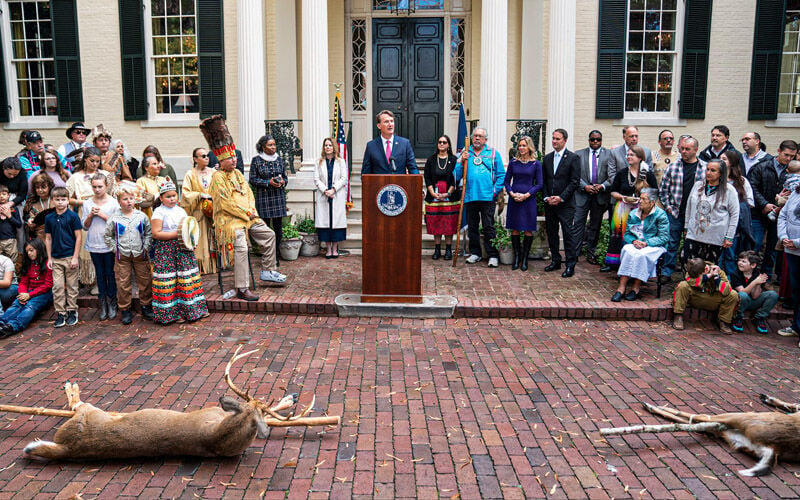
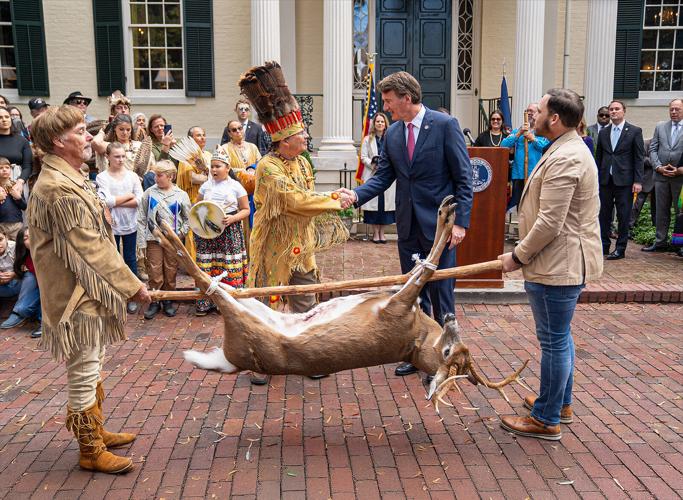
Every year since 1677, as part of treaties established in Colonial Virginia, the Pamunkey and Upper Mattaponi tribes have paid a tribute to the Commonwealth of Virginia. This tribute had typically taken the form of deer, turkeys, and other game harvested on tribal lands and replaced the paying of taxes.
This act was formalized in 1677’s Treaty of Middle Plantations by King Charles II. The treaty came about because the Virginia colonists slaughtered the natives as part of Bacon’s Rebellion and it acknowledged that the Native Americans would have the right to possess land and to hunt game.
The tribute itself is part of the rich history of the Old Dominion, says Lee Walker, the retired outreach director for the Virginia Department of Wildlife Resources (DWR).
“It’s really important to understand how the Native Americans interacted with the English settlers in the 1600s,” he said. “Their gifts of game helped keep the Jamestown settlers alive during those early years. It’s also amazing to understand that every Virginia governor since 1677 has participated in receiving the gift of game as a way of the Native Americans paying their taxes.”
People are also reading…
Enduring treaty traditions and conservation leadership
But the Upper Mattaponi and Pamunkey are not just adherents of tradition. Walker says these tribes are directly involved with Virginia’s conservation efforts, just as they have been for hundreds of years before the arrival of Europeans. For example, the Pamunkey have assisted the DWR in shad restoration projects, and both tribes are well known as advocates of sound wildlife and habitat management.
Additionally, the Pamunkeys built a hatchery in 1918 to raise and release shad. The tribe recognized that this fish species was imperiled and took it upon themselves to remedy the situation. The Pamunkeys also have been involved in studying the status of Atlantic sturgeon and looking for ways to improve the species’ plight. They have commissioned studies on the current status of the Pamunkey River’s water resources, including riparian zones, wetlands, and wildlife habitat in general.
Ryan Brown, DWR executive director, acknowledges the historical importance of the Old Dominion’s Native Americans in regard to the state’s fishing and hunting heritage.
“The Pamunkey, Upper Mattaponi, and Virginia’s other tribes are the state’s original conservationists and wildlife managers,” he said. “One of the DWR’s goals is to build even greater relationships with the tribes, not only for the benefit of joint conservation work, but for overall assistance in planning the management of all Virginia’s wildlife.”
Upper Mattaponi history and land recovery
To learn more about Virginia’s Native Americans and their wildlife management, I contacted Chief Frank Adams of the Upper Mattaponi. It should be noted that former Governor Ralph Northam appointed Adams, in recognition of his career as a conservationist, to the DWR Board, where he served for four years.
“The Native Americans were the original stewards of what is now Virginia and the United States, and our knowledge of the land fed us and helped us to survive,” Adams said. “There is something about living on your own land and being one with Mother Earth and nature. The Upper Mattaponi lost their land through wars, battles, and government policies.
“When in the 1700s we were scheduled to go to a reservation, we rebelled against going. Instead, we kept going further and further up the upper Mattaponi to where the river became so small, it was impossible to reach us by boat. We hid out until the mid-1800s, about the time the Civil War broke out.”
Fascinatingly, Adams reveals that the Old Dominion once hosted some 30 to 40 different tribes. Obviously, the Upper Mattaponi, Mattaponi, and Pamunkeys lived in close proximity in Tidewater, but the Catawba Indians often travelled eastward to trade with them. The chief says that the Catawba possessed the perfect stone for knapping, which led them to create especially lethal points for spears and tools such as axes. Those stones were thus in high demand in the eastern reaches of the Commonwealth. When lives depended on a tribe’s ability to successfully hunt game, the Catawba’s “rocks” were crucial.
In January 2018, the Upper Mattaponi received federal recognition from the United States government. Later, the 2020 Coronavirus Aid, Relief, and Economic Security Act, or the CARES Act, resulted in the tribe receiving federal money, which they used, in conjunction with their own funds, to repurchase historical land in their traditional home base of King William County.
Adams reports that the Upper Mattaponi were able to re-acquire one parcel of 866 acres about a mile long, all on the Mattaponi River. At this writing, they own some 1,500 acres.
“We have the intention of building some affordable houses on our land,” Adams said. “So many members have moved away for better jobs and to gain education, this might be the incentive for them to return home. We only have 672 what is known as ‘enrolled citizens.’ We’ve always been known as water people, so it’s very meaningful that our land is on the Mattaponi Watershed.
“We want to be able to do what we historically have done: to live on our own land and fish and hunt it. And also to clear land and farm it. This is a huge cultural emphasis for us, to re-acquire as much of our former homelands as we can.”
Managing land, water, and wildlife
Now that the Upper Mattaponi have reassembled some of their historic land, they are doing their best to manage it. Among those activities, says Adams, is monitoring the water quality of the watershed. Eventually, the tribe wants to restore and/or improve the populations of native fish such as shad, herring, and sturgeon. The latter species’ numbers have especially plummeted.
“The invasive blue catfish has taken over many of Virginia’s tidal rivers,” Adams said. “The blues have migrated up the river and are really hurting the shad and herring populations, which were already really low. So, we have developed the policy of catching, keeping, and eating them. Blues have no natural predators and are prolific reproducers. The cat is also hurting two very popular fisheries: largemouth bass and white perch.
“But blues are delicious to eat. We worked with our local House of Delegates Representative Keith Hodges to try to pass legislation so that we can catch them to sell to restaurants and fish markets. That would help keep blue cats under control and provide us with a source of income. However, the legislation did not pass.”
Deer-drive traditions and modern hunting
One of the most interesting things that Chief Adams told me is that the Upper Mattaponi and other Native American tribes were the original deer drive hunters.
“Deer drive hunting is part of our tradition,” he said. “The goal was to get meat for the winter. So, the young men would leave their villages and would not return until they killed what had been decided would be the quota to feed everyone through the winter. The way the hunts worked was that scouts were sent to observe the deer and figure out their movements.
“Then with that knowledge, the young warriors would drive deer to where men were waiting with their bows and arrows. When the men returned, the women would work up the meat and hides. The way hunt clubs conduct drives today is very similar to what we did. Of course, today hunters have game cameras to help them figure out game movement.”
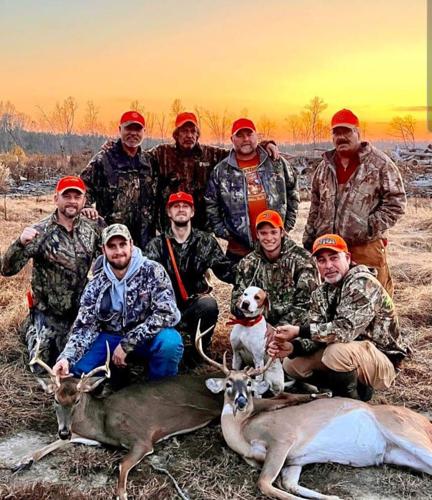
Deer hunting on the Pamunkey and Mattaponi tribal lands today is a long-standing tradition. Chief Adams said, “The Upper Mattaponi and other Native American tribes were the original deer-drive hunters. Hunting the whitetail today remains part of our Native American heritage, and their success sets a high standard.”
Adams emphasizes that the Upper Mattaponi have excellent relationships with DWR and the Virginia Department of Forestry (DOF). Currently, the tribe is working with both entities to improve their land by using best management policies. Much of the land has been overly clear-cut, which presents a challenge as very few bearing oaks exist.
The chief says the tribe also appreciates that DWR always participates in their annual pow wow and conducts youth outreach that benefits the young people. DWR fisheries biologists also do an excellent job of monitoring the Mattaponi River and keeping abreast of water quality issues.
Partnerships for fish and wildlife restoration
Adams says that Leigh Mitchell, the Environmental and Cultural Protection Director for the Upper Mattaponi, especially works closely with DWR.
“We actually have been doing quite a lot with government agencies,” Mitchell said. “We don’t yet have a hatchery, but we have worked with the U.S. Fish and Wildlife Service and DWR for tribal members to receive training on fish propagation and all the skills that go along with that. The goal will be for us to one day to help propagate and enhance populations of such species as alewives, blueback herring, and freshwater mussels.
“These have been mutually beneficial relationships because we have shared with those agencies the Upper Mattaponi’s many-generations-old knowledge of where and in what kinds of habitats those species live. We’ve also assisted DWR with a blue catfish survey. And we recently were awarded a grant to work on restoring Atlantic sturgeon to the Mattaponi River. Again, we could not do all these projects without having this cooperation and our knowledge. The saying ‘It takes a village’ to accomplish something is certainly true in these cases.”
Mitchell added that the Upper Mattaponi are “also at the table” with DWR concerning monitoring and doing surveys regarding game populations on their recently purchased historical land. Baseline data is being established.
Bruce Ingram, staff writer for Whitetail Times, lives in Fincastle, Virginia with his family. Ingram is a serious whitetail hunter and fisherman. His hunting and fishing articles have been published in state, regional, and national publications.
- November 4, 2026


