


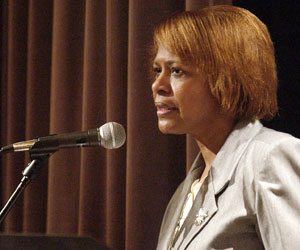
Ambassador Pamela Bridgewater moved beyond the barriers of segregated Fredericksburg to help unite a divided South Africa.
Bridgewater, a former deputy assistant secretary of state for African affairs, served in the U.S. Embassy in South Africa and was later U.S. consul general in Durban, South Africa, during the disbanding of apartheid, that nation's racist caste system that denied full citizenship to its black and brown majority.
As the first black woman to hold the Durban post, Bridgewater nurtured sensitive dialogue between Nelson Mandela's African National Congress and the Zulu-led Inkatha Freedom Party during the period leading up to the end of apartheid and the establishment of a truly democratic South Africa.
"There was a lot of jockeying for power," recalls Bridgewater, currently diplomat in residence at Howard University's Ralph J. Bunche International Affairs Center. "I tried to get the folks to think of themselves as South Africans first . . . that this was a land that they could not allow to be destroyed by their rivalries, and they could find a way to share it all."
People are also reading…
By the end of her time in South Africa, she had so earned the respect and trust of Mandela, by then the nation's president, that he invited her to a private farewell lunch in his home.
Bridgewater, the daughter of a bank teller and a jazz trumpeter, was born in 1947 in Fredericksburg and graduated from Walker-Grant High School.
Her teachers inspired her to excel, she says, and the French she learned there would so impress people in her foreign posts that they asked where she learned to speak the language so well.
She earned a bachelor's degree in political science from Virginia State College (now University) and a master's degree in political science from the University of Cincinnati before launching a teaching career.
"I taught at Bowie State University and at Morgan State during the period of the liberation struggle in southern Africa, in particular. I was able to work with the students and enhance their knowledge and interest in what was happening on the continent," Bridgewater says."This is when I guess my interest in Africa peaked."
Recruited by a State Department struggling to attract women and minorities, she entered the U.S. Foreign Service in 1980. Her service has included stints in Brussels, Belgium; Kingston, Jamaica; Nassau, The Bahamas; and in Benin, where she was the U.S. ambassador.
In December 2002, she was appointed U.S. deputy assistant secretary for African affairs, overseeing diplomatic matters in 16 West African countries.
As she battled the entrenched, state-sanctioned racism of South Africa, Bridgewater drew from her formative years in Virginia. "I thought that the experience I had in the segregated community helped me understand the importance of bridging differences," she says.
So it was only appropriate that during her final days in South Africa, her staff presented her with the farewell gift of a framed caricature. It read: "Pamela - the bridge over troubled waters."


