


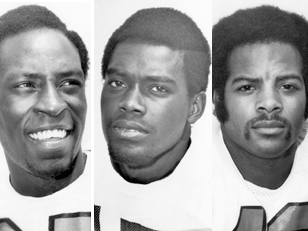
From the moment he arrived in Charlottesville, Harrison Davis had to deal with racial hostility. In 1971, he and three other men — Kent Merritt, Stanley Land and John Rainey — became the first African-Americans to play varsity football at the University of Virginia.
On a September day in 1972, Davis really was hearing it from fans. He wasn't sure it was all about skin color, though.
"I don't know if it was racially motivated," he said. "We were down 14-0 to Virginia Tech."
Times have changed. The Cavaliers now are led by a black coach, and the student body more accurately represents the state.
Other things haven't changed. Virginia's players, of every background, can't stand the Hokies.
"We've got to beat Tech," Land said. "Even after 40 years, I still want to beat Tech."
People are also reading…
* * * * *
The story of the four men who broke the color barrier at U.Va. remained mostly untold until two years ago, when filmmaker Kevin Edds discovered it while producing his movie "Wahoowa," a documentary that chronicles the history of Virginia football.
"I think it could be its own documentary, quite frankly," he said.
Talking to the four today, they say history has given them a greater understanding of what they did.
They arrived in Charlottesville not as defiant trailblazers, but young men who simply wanted to play football and stay near home. They enrolled in 1970, but because freshmen had to wait a year, didn't play their first varsity game until 1971 — 40 years ago.
"We felt we could make a difference as far as winning on the football team," Merritt said. "I realize now that whole event, that whole time period, meant more to others than we probably realized."
That's not to say there weren't issues. Hate mail and threats arrived for the players from boosters and graduates who weren't happy with the direction the school was moving. It was a time of transition for U.Va., which had also just begun accepting female students.
"It would be inaccurate to try to paint it as the perfect, idyllic scene at U.Va., because it wasn't," Edds said. "I'm sure it was challenging for them."
No one felt that heat more than Davis, who was named the Cavaliers' starting quarterback. After Davis earned the job, the team's other quarterback, Bill Troup, transferred to South Carolina.
Coincidentally, the Wahoos played their first game in 1972 against Troup and the Gamecocks.
"You talk about hostilities," Davis said with a laugh. "Oh, yeah. It was bad."
The Cavaliers won, but Davis separated his shoulder and tore a ligament in his thumb. With the rivalry game against Virginia Tech looming a week later, the team began to prepare backup George Allen Jr. for the job.
* * * * *
Davis shocked everyone by playing against the Hokies in Scott Stadium. His determination was not as appreciated by the crowd, especially when he opened the game with two interceptions.
On the bench, he started to hear it from the Virginia faithful.
"It was just horrible, the way they were booing and the things they were saying," Merritt said. "At that point, Harrison promptly gave the crowd the finger, and led us back to victory.
"It was one of the best games we ever played during my tenure at Virginia."
It also proved to be the high point for that year's Virginia team, which won the game 24-20. The Cavaliers couldn't sustain the momentum generated by a 2-0 start and finished 4-7, the best they'd do for the next seven years.
* * * * *
Now 40 years later, the memories aren't all about football. One relationship the players have maintained is with their freshman coach, who helped guide them in their transition to college. That man was Al Groh, who later became the head coach.
"It's not uncommon to get a text message from Coach Groh on holidays, and a telephone call if he's passing through the area," Land said.
Land lives in Houston, where he started a company that distributes industrial parts for oil and gas production. Merritt works for U.Va. in the department of history, and Rainey lives in the Tidewater area. The three try to attend a game together annually.
Davis has returned for a game only once, a few years ago. He works as a firefighter in Westminster, Colo.
"It's just like football, as far as I'm concerned, except without all the cheering," he said. "Of course, you don't get the jeering either."
He said distance is an obstacle to attending games now, but for many years after he graduated, the memories of the racial taunts he endured were fresh in his mind.
"I don't know if it affects much of anything now, but for a while there, yeah, I had kind of soured as far as going back," he said.
He added he watched last Saturday's Florida State game on TV and was impressed with the team's play, particularly "because I can't stand FSU."
Davis also cited Groh as a positive influence during his time there.
"We had great support systems," he said. "We were able to make it through and still have some positive memories of the situation."
* * * * *
Sitting in the coach's office, Virginia's Mike London, an African-American who went to school in Tidewater, reflects on the progress that has been made.
"When I got the job, I said that I stand on the shoulders of a lot of people who came before me," he said. "Certainly what those men did should be honored."
Edds agrees, and featured the story prominently in his documentary, a clip of which is available at UVAFootballHistory.com.
For the players, it's been a different journey of significance. They started as kids looking to play football, and now realize the role they had in Virginia history.
"We didn't see ourselves as pioneers, we were just part of the football team," Land said. "As I look back now, some 40 years, it was a tremendous change in our lives at that time, and certainly a tremendous change for the university."


