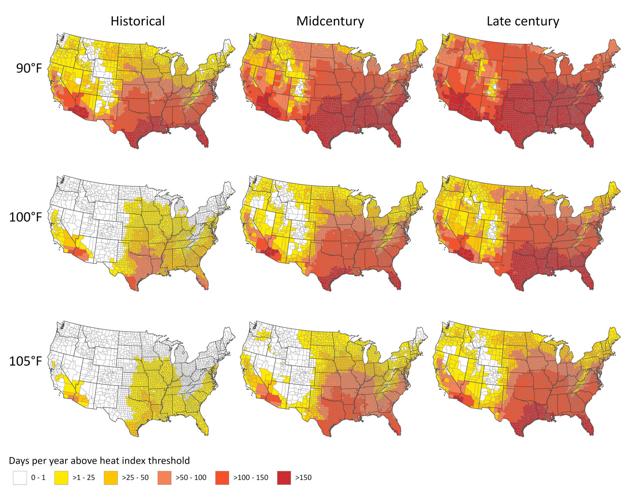
The Union of Concerned Scientists published a study last summer looking at how climate change will affect the timing and distribution of extreme heat waves in the continental United States. The left column shows the historical average number of days with a heat index above 90 degrees (top row), 100 degrees (middle row) and 105 degrees (bottom row). The middle column shows the same for mid-century if nothing is done to reduce carbon emissions, and right column shows the same by the end of the century if nothing is done. Note that Virginia High School League guidelines recommend restricted outdoor activity above 90 and none above 105.
Courtesy of Kristina Dahl/Union of Concerned Scientists
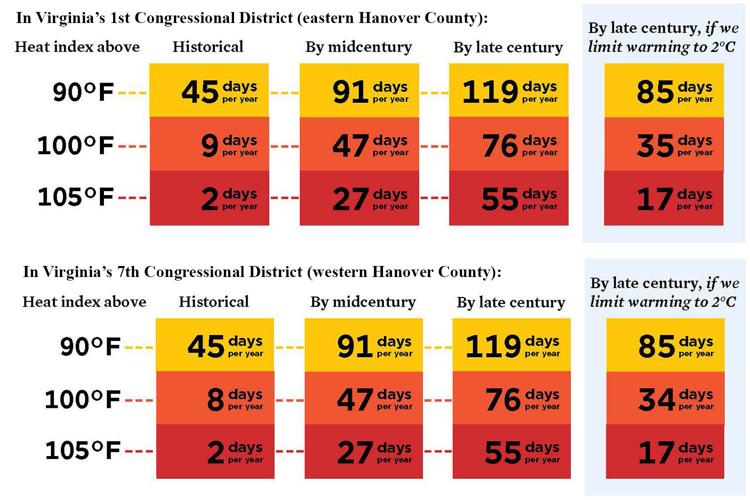
According to a study published last summer by the Union of Concerned Scientists, the average frequency of days with extreme heat would rise as shown here for Virginia' 1st Congressional District (top) and 7th Congressional District (bottom).Taking steps to hold global warming to 3.6 degrees would limit the increase in days with extreme heat.
MECHANICSVILLE – The Richmond metropolitan area is all too familiar with stories of athletes felled by heat injuries during practices or competition. Despite great strides in understanding many of the risk factors and how to manage them, athletes continue to sicken, even die, from overdoing it in the heat.
kAmk6>ms2G6 {2HC6?46 42? 36 C624965 2E k2 9C67lQ>2:=E@i5=2HC6?46o>649=@42=]4@>Qm5=2HC6?46o>649=@42=]4@>k^2m]k^6>mk^Am
Deadly Practice
Editor’s Note: When I more or less wrapped up the "Deadly Practice" series in October, I was not sure I wanted to raise the issue of climate change and heat injury risk. But I was persuaded to reconsider.
This is part of the final (no kidding) installment in the series.
MECHANICSVILLE – When I began work on the Deadly Practice series, Mike Craven of Mike’s Olympic Gym had been preaching the gospel of fitness t…
The Union of Concerned Scientists published a study last summer looking at how climate change will affect the timing and distribution of extreme heat waves in the continental United States. The left column shows the historical average number of days with a heat index above 90 degrees (top row), 100 degrees (middle row) and 105 degrees (bottom row). The middle column shows the same for mid-century if nothing is done to reduce carbon emissions, and right column shows the same by the end of the century if nothing is done. Note that Virginia High School League guidelines recommend restricted outdoor activity above 90 and none above 105.
Courtesy of Kristina Dahl/Union of Concerned Scientists
According to a study published last summer by the Union of Concerned Scientists, the average frequency of days with extreme heat would rise as shown here for Virginia' 1st Congressional District (top) and 7th Congressional District (bottom).Taking steps to hold global warming to 3.6 degrees would limit the increase in days with extreme heat.