





Editor's Note: This story has been updated to include an additional statement from the school district that was submitted after the article was printed.
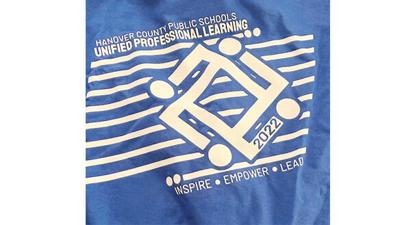
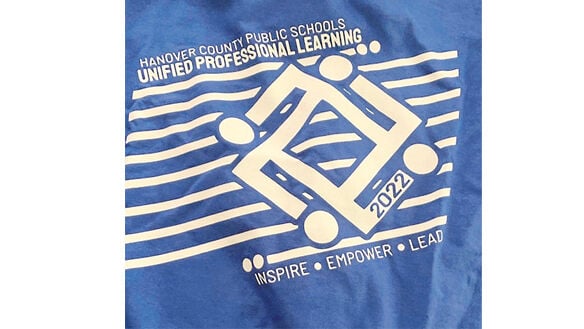
An online uproar ensued last week after a Hanover County Public Schools (HCPS) T-shirt design quickly circulated, with online users condemning the logo design for resembling a swastika.
The printed shirts were distributed to staff during last week’s Unified Professional Learning Conference, which was a three-day conference that brought educators and staff from across the school division together for a series of engaging sessions, according to a now-deleted HCPS Facebook post. The post, showcasing the first day of the conference, along with other posts displaying the logo and shirt were promptly removed from the HCPS Facebook page after online backlash emerged on the morning of Wednesday, Aug. 3.
People are also reading…
Hanover Superintendent of Schools Dr. Michael Gill issued a formal apology addressing families, faculty and staff shortly after community members raised concerns with the logo.
According to Gill, the logo was designed by a teacher who intended for the image to represent “four hands and arms grasping together – a symbol for unity for [the] all-county professional learning conference” and was “created without any ill-intent.” In response to negative feedback, they stopped distributing the T-shirts and began working to remove them from all conference materials, Gill stated.
“We are deeply sorry for this mistake and for the emotions that the logo has evoked by its semblance to a swastika and, by extension, to the atrocities that were committed under its banner,” Gill stated. “Unquestionably, we condemn anything associated with the Nazi regime in the strongest manner possible.”
Gill wrote that HCPS is committed to inclusion and ensuring that all students, faculty, staff and community members feel welcome, safe and secure in the school division.
“We truly regret this error and are sorry that it has distracted from the great work that is being accomplished through this conference and throughout the school division, which will help us to continue to uphold our longstanding Tradition of Excellence by supporting all students and their unique needs,” Gill wrote.
The Jewish Community Federation of Richmond responded to Gill’s apology statement with the Facebook post:
“We appreciate this swift response from Superintendent Michael Gill. ADL Washington D.C., Virginia Center for Inclusive Communities, Virginia Holocaust Museum and JCFR look forward to continuing to work with the Hanover County Public School system as we all strive for an inclusive education space & community,” the post stated.
Online discussion over the logo continued to circulate following Gill’s apology, with various social media users expressing concern over how the logo was approved initially.
Rachel Levy, a candidate for the Virginia House of Delegates, was among the Twitter users that posted updates and comments on the controversy throughout the day.
“I am outraged but not surprised that Hanover Schools Superintendent Mike Gill would blame a teacher for his approval of the logo,” Levy stated in a tweet. “Where does the buck stop? Apparently, never with him or his office. Unacceptable.”
Ethan Lynne, a Patrick Henry High School graduate, also posted of the controversy on Twitter and received a number of messages concerning the logo on Wednesday.
“At first, I was appalled and dumbfounded,” Lynne said. “I always try to give people the benefit of the doubt, but… I’m just a little confused at how no one caught this in the development process… If people were able to recognize it within mere minutes of seeing a photo of it, there’s no way that in the development process of this logo and it getting printed on merchandise that no one caught that.”
Lynne said he appreciated how the school division ceased distribution of the logo and offered an apology, but he believes the blame was placed solely on the teacher in Gill’s apology letter. In addition, he wished the letter expanded on the process of approving logo designs and how it wasn’t caught.
“I think that we need to look into review panels for any future logos for school,” Lynne said.
Lynne referenced how the Community Equity Advisory Board recommended the appointment of a diversity, equity and inclusion director and believes this incident “further showcases that they need to follow through with that.”
Hanover NAACP issued a statement on Wednesday afternoon in response to the logo.
“The Hanover County NAACP is aware of and deeply troubled by the decision of Hanover County Public Schools to use a logo resembling a swastika to represent their Professional Learning Programs,” the letter stated.
The letter furthers that the incident is “another example of the urgent need for required training and professional development in diversity, equity and inclusion for all employees of Hanover County Public Schools, to include our Board of Supervisors and School Board members. The hiring of an Equity and Diversity Director is imperative as has been requested for years by our organization and the Hanover Community Equity Advisory Board.”
The letter stated that Hanover NAACP appreciates Gill’s issued apology.
“However, mere oversight by one individual cannot explain this pattern of a lack of diversity, and the refusal to make substantive changes that would result in the new direction for our schools as asked for in our Open Letter of July 25, 2022,” the letter stated.
Chris Whitley, HCPS assistant superintendent of community engagement and legislative affairs, offered a statement to The Local on how the school division will avoid similar occurrences in the future.
“This was developed as part of our instructional team’s planning for the conference. This has historically been a decentralized, informal process,” Whitley wrote. “Moving forward, however, we are reevaluating the process by which logos such as this are reviewed.”
Whitley offered an additional statement to The Local on Tuesday, Aug. 9 addressing comments made regarding Gill's apology letter.
“Dr. Gill’s message was intended to acknowledge the concern, provide the facts of the situation (an honest mistake), and to apologize for the pain it may have caused, not assign or displace blame. Accordingly, neither Dr. Gill nor his senior leadership team were abdicating responsibility for the mistake. The apology and broader explanation came directly from Dr. Gill. He signed the message, thus taking full ownership for the message, and, more importantly, the mistake,” Whitley wrote.