




POWHATAN – A tense two nights of public meetings brought the issues of education and racism to the forefront last week in Powhatan County.
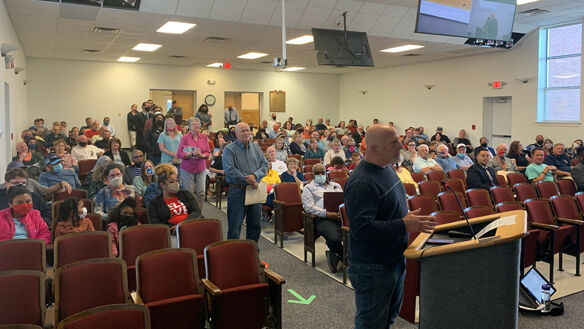
Local elected officials saw how passionate residents were on these issues when they came out in large numbers to speak at the Powhatan County Board of Supervisors meeting on Monday, May 10 and the Powhatan County School Board meeting on Tuesday, May 11.
Both meetings – which were held at the Village Building and Pocahontas Landmark Center, respectively – were packed with people, many of whom made their voices heard. In all, 37 people spoke during the board of supervisors meeting (all but one on this topic) and 21 in front of the school board, with some overlap of speakers.
The core issue started with the question of what people feel should or should not be taught to students in Powhatan schools. But over the course of two nights and because of the expansion beyond the initial purview of the school board, the scope of topics expanded to issues of budget controls, the validity of Critical Race Theory, racism, and, in some ways, Powhatan’s very identity.
People are also reading…
While some of the topics discussed were already highly likely to be brought up at the school board meeting, comments made a week earlier by supervisor Mike Byerly, who represents District 3, heightened the tensions and brought them boiling over a night earlier.
During the discussion about the budget on May 3, Byerly spent 30 minutes talking about school funding and implying he would base his decision about the budget on what the school may be teaching or ideologies it may be promoting.
While the broader topics were always present, many of the people who spoke to the supervisors on May 10 addressed Byerly in particular, either offering support and appreciation for his comments or expressing hurt from them and asking for an apology. His questioning of school curriculum and what taxpayer dollars were being spent on, as well as the way he approached the subjects, brought strong reactions in many ways.
In the days following the May 3 meeting, two different petitions were started as a result on Change.org on the topic. The first, which was created on May 7, is a petition in support of Byerly, praising him for having the “courage to speak up and ask the ‘hard questions.’ The second petition, which was created on May 8, called Byerly’s comments dismissive of the lived experience of people of color and asked for an apology.
After the last of the speakers had shared their thoughts with the school board, the actual topic that many people said drew them to the meetings – hearing the school division address Critical Race Theory (CRT) in the schools and the use of controversial resources – was treated almost as an afterthought. The school board took a brief break between the public comment period and moving on with the rest of the agenda, and the update on the development of a new elective African American History class – the catalyst that started this discussion – was held within minutes of calling the meeting back to order. But by that time more than half of those who came to the meeting had already left.
Dr. Eric Jones, superintendent, assured the audience that remained that the course is being built for Powhatan and will reflect the community, including the inclusion of local history. He stressed multiple times that the controversial New York Times’ 1619 Project that was spoken about by so many will not be used as a resource for developing the class.
“We stated that back in February and we have stated it emphatically ever since then – that the 1619 Project will not be part of the curriculum of this course. There are lots of other, very valid curriculum resources that can teach a robust African American History course that will allow students to critically examine African American contributions to our country and their role within that country. That is what our goal is and that is the goal of the course,” Jones said.
Jones also stated unequivocally that they “have no plans to, have never had any plans to, and will not use Critical Race Theory in this course.”
Recent history
While discussions about racism and education are by no means a new topic, the current iteration of the local discussion began to bubble over in December 2020. The school board was asked to consider the course planning guide for the next school year, and on that list was the elective African American History class.
Although the final class curriculum would be built by Powhatan County Public Schools, the Virginia Department of Education, which offered the framework for the course, also included with it a list of possible resources school divisions could use to create their courses. Among those was the 1619 Project.
Even before the board had its first discussion on the issue on Dec. 8, 2020, members said they had been receiving concerned emails and calls. At the school board’s Dec. 10 joint meeting with the board of supervisors, 10 people spoke about the ideology behind the terms equity, diversity, and inclusion, which have been a big focus for PCPS in recent years. While none of the speakers stated they were against approving the history class, a few did specifically oppose using the 1619 Project as a resource.
At the Jan. 12, 2021, meeting where the school board actually approved the course guide, several people spoke in support of the history class, and some even defended the 1619 Project as providing a perspective that challenges people to think critically about history.
The school board did ultimately approve the course guide with the new elective on Jan. 12, but it was with the understanding that staff would be coming back with updates from the committee of educators working on it.
The first update on the African American History class was scheduled for the school board’s May 11 meeting. In addition to his assurance that neither CRT nor the 1619 Project would be part of the course, Jones said people interested in the development of the course can follow its progress in posts on the school division’s website, http://www.powhatan.k12.va.us.
He also pointed out that 31 students at Powhatan High School have signed up for the elective course and another 43 have it listed as an alternate in case they are unable to get into one of their other electives. He said he is happy to see so much interest in the course.
The public speaks
On May 10 and 11, a combined total of 46 people spoke at the two meetings (11 people spoke at both) regarding these topics. Both meetings saw some high emotions, including small arguments among speakers at the board of supervisors meeting and the school board addressing outbursts and trying unsuccessfully to make everyone in the audience adhere to the mask mandate.
While there wasn’t a strict dividing line that every speaker fell on one side of, many of the comments tended to lean to one side or the other.
On one side were people who agreed with Byerly’s comments; spoke of the need to keep CRT out of Powhatan schools; said they did not want to encourage issues that cause obvious divisiveness in the community, and said that since it is the board of supervisors’ job to oversee the budget, Byerly had a right to ask the school board for transparency.
On the other side were people who said they were deeply hurt by Byerly’s comments as dismissive to the realities of racism they face – both in the schools and the communities; argued for the need to have the African American History class to offer people the opportunity to learn more about the contributions of people of color; argued for the inclusion of more perspectives when looking at history; outlined examples of racism observed by students in Powhatan schools, and requested the board of supervisors fully support the schools.
Sarah Taylor, who said she started the petition in support Byerly, spoke at both meetings. While she believes racism still exists and children need to learn about other cultures, she said that CRT and the 1619 Project are not the ways to teach it. She and many other speakers said these theories focus on oppression and division and deny the principals and freedom on which the nation was founded.
Rebecca Courtright, who started the petition asking for Byerly’s apology, told the board of supervisors that his approach to the issue didn’t involve good budget questions. She said she thought he was a supervisor elected to represent all of his constituents, “not a Fox News commentator.” She also said his comments hurt people in the community because the words dismissed their experiences.
Joe Ordia, who spoke at both meetings, shared the story of his father emigrating from Nigeria to the United States, working hard, and succeeding. He argued that CRT is about dividing and conquering people and teaching black and white children that they have prescribed roles from birth they cannot escape.
DaLynn Prince-Jones talked to the supervisors about the racial slurs Powhatan students of color experience in school and the racism she experiences as an adult despite her many accomplishments. She questioned whether Byerly’s comments about not seeing racism were really just about turning a blind eye.
Several high school students also spoke in person or via Zoom and recounted examples of racism they have seen firsthand.
Meredith Perry told the supervisors she supported Byerly because it is the board’s job to hold the purse strings and said he shouldn’t have been attacked and labeled a racist (and the same for those who support him) for asking questions on behalf of constituents.
Fannie Snead read a statement on behalf of the Powhatan Chapter of the NAACP to the school board that included the school division’s work during COVID-19. She talked about the importance of students learning history from different perspectives, including people of different races, religions, genders, and other groups throughout the nation’s history.
Darrell Griffin told the supervisors he is not concerned about history being taught in schools as long as it is accurate. However, he said the schools are swerving into his lane by teaching his child things that he finds reprehensible.
Christine Cadigan questioned comments Byerly made regarding a student survey done at the high school where they were asked about bullying and racism being issues in their school. Byerly had pointed to the lower numbers on the “agree” side of the survey, to which Cadigan questioned what he considered an acceptable threshold for allowing bullying and racism in schools before it is actually viewed as a problem.
That survey was highlighted in a PowerPoint created by two PHS teachers that Byerly heavily criticized in his May 3 comments. One of the teachers, Nashae Jones, noted to the supervisors that the PowerPoint was created for a private presentation at a professional conference. Despite all of the animosity it stirred up after being shared in Powhatan, she remarked that only one parent was actually willing to meet and discuss their concerns with her and that she never heard from any of the supervisors to gather information.
Amanda Cozack pointed out that if these issues were this divisive to adults, how much more confusing would it be for children to tackle.
Dr. Heather Williamson gave several examples of what she said were CRT in practice, both in Powhatan and elsewhere. She talked about a lesson using a book called “Julian is a Mermaid” being inappropriate for young children or a teacher using examples such as kneeling during the National Anthem to talk about peaceful protest.
On this note, at the end of the school board meeting, Eric Jones addressed how some of the specific concerns that were brought to the schools’ attention were addressed, sometimes with changes in the curriculum or materials used and sometimes not. But he said the best way to address parent concerns would be for them to bring them to the teachers, school administrators, or even to him directly in a conversation over the phone or in person.
Laura McFarland may be reached at Lmcfarland@powhatantoday.com.